
Stewart County Probate Court Duties
Stewart County Probate Court is led by Probate Judge Jimmy Brazier. The county Probate Judge page says the judge performs judicial, ministerial, and clerical duties. It lists jurisdiction over probate of wills, letters testamentary and administration, controversies over executorship or administration, sale and distribution of estate property, guardianships for minors and incapacitated persons, returns by executors and guardians, surety issues, and mental-health matters under Georgia Title 37. Those are probate records, but they are not all open in the same way.
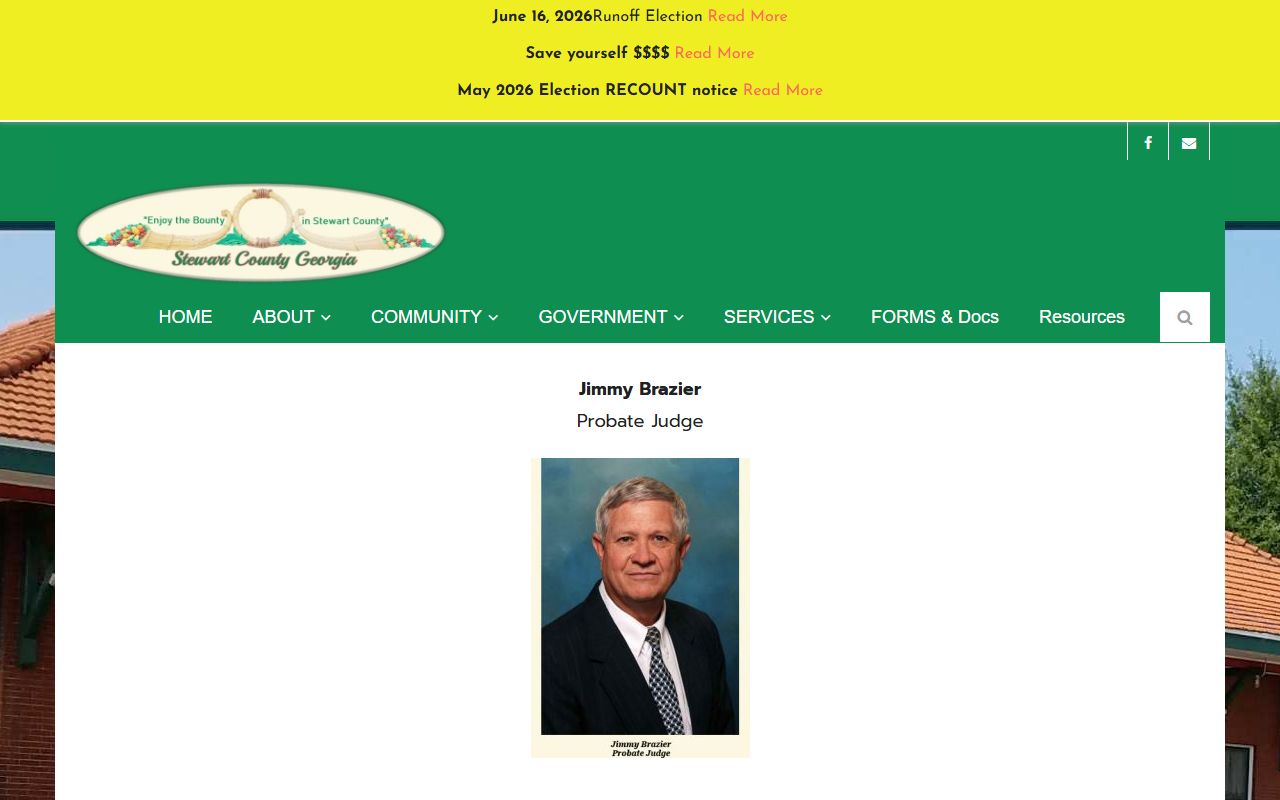
The Stewart County Probate Judge page is the local source for Probate Court authority and contact routing. The image below is included because it is the successful page capture assigned to Stewart County probate records.
The county page is also the source for Probate Court duties beyond estates, including marriage licenses, some traffic matters, public-officer bonds, and certain county administration duties.
Probate Court records are separate from Superior Court divorce files and felony case files. A will, estate administration, or guardianship request should start with Probate Court. A divorce decree or Superior Court appeal should go to the Clerk of Superior Court. When a probate matter becomes contested or appeals into another court, the record path can split, so the office should confirm which file is being requested.
Stewart County Probate Terms
Probate filings use short legal words that can change the record search. Knowing the term helps the clerk identify the right file type and reduces the chance of asking for a broad estate record when only one certified letter is needed. These terms are used in Georgia probate practice and match the Stewart County Probate Court categories found in the research.
- Testator
- A person who made a will before death.
- Executor
- A person named in a will to carry out estate duties after appointment.
- Intestate
- A death without a valid will, usually handled through administration.
- Guardianship
- A court case about personal care or decisions for a minor or incapacitated person.
- Conservatorship
- A court case about money or property management for a protected person.
- Letters
- Court-issued proof that a representative, executor, or administrator has authority.
Search Stewart County Probate Records
No official Stewart County probate online search fields were located. That means a search for Stewart County probate records should begin with a phone or in-person request to Probate Court. A requester should know whether the file involves a decedent estate, no-will administration, guardianship, conservatorship, marriage license, certified copy, bond, return, or mental-health matter. Asking for the exact file type matters because some probate estate records are public, while guardianship, conservatorship, mental-health, minor, medical, and sealed materials may be restricted.
- Identify the probate matter: will, estate, administration, year's support, guardianship, conservatorship, bond, return, or certified copy.
- Call Probate Court to confirm the required Georgia form, filing fee, identification, and whether a hearing is required.
- File at Stewart County Probate Court in Lumpkin unless the office says the matter belongs in Superior Court or another court.
- Provide the names, date range, heirs or beneficiaries, ward information, original will, or case number if known.
- Complete notices, publication, bond, inventory, returns, or hearings as ordered by the court.
- Request certified letters or orders from Probate Court after issuance.
Note: The county open-records form can help with county agency records, but probate court procedure may control probate files.
Stewart County Probate Court Contacts
Stewart County has one local Probate Court contact point in the source material. The DPH vital-records listing gives a direct probate/vital-records phone number, while the county directory routes Probate Court through courthouse extensions. The county website uses the courthouse address for court and county offices, and the county office mailing address appears as a general county mail route. Because a separate probate mailing address was not confirmed on the Probate Judge page, a filer should verify the correct mailing address before sending original wills or petitions.
Stewart County Probate Court
Judge: Jimmy Brazier
1764 Broad Street
Lumpkin, GA 31815
(229) 838-4859
Extensions 215 and 216 through (229) 838-6769
stewartcountyprobatecourt@gmail.com
For marriage records tied to Probate Court rather than an estate case, the related marriage and divorce page describes the DPH and local court split for copies. Probate estate records should stay with the probate office unless an appeal or separate Superior Court case exists.
Stewart County Probate Fees
A Stewart County probate fee schedule was not located in official county sources. The build should not borrow a fee table from another Georgia county. Probate fees can vary by petition type, copy type, publication requirement, sheriff service, bond, and whether certified letters or certified copies are needed. Before filing, ask Probate Court for the current amount and acceptable payment methods.
| Probate Item | Amount | Local Source Status |
|---|---|---|
| Will probate petition | Not located in official sources | Confirm with Stewart County Probate Court. |
| Administration without will | Not located in official sources | Confirm before filing. |
| Guardianship or conservatorship filing | Not located in official sources | Confirm form and fee with the court. |
| Certified letters or orders | Not located in official sources | Ask the court for copy and certification costs. |
| County open-records copies | $0.10 per page where the county form applies | Agency-record fee, not a probate filing fee. |
Georgia law gives Probate Court jurisdiction over estates, guardianships, and related powers in O.C.G.A. 15-9-30. That statute is a jurisdiction source, not a Stewart County fee schedule.
What Stewart County Probate Records Show
A public estate file may include a petition, will, heirs or beneficiaries when public, oath, bond, letters testamentary or administration, notices, inventory, returns, orders, sale or distribution papers, and closing or discharge entries. A guardianship or conservatorship file may include petitions, appointment orders, bonds, inventories, annual returns, and court orders. Some records show the person who requested appointment and the authority that was granted. Others show only a narrow certified letter needed for a bank, title office, or benefits request.
| Record Type | Common Contents | Access Concern |
|---|---|---|
| Estate with will | Will, petition, executor, letters, orders, returns | Some exhibits may be limited. |
| Estate without will | Administration petition, heirs, administrator, bond, orders | Public status depends on file contents. |
| Guardianship | Petition, ward details, appointment, reports | Minor, medical, and protected-person data may be restricted. |
| Conservatorship | Assets, bond, returns, orders | Financial and protected-person details may be redacted. |
Restricted Stewart County Probate Records
Probate estate files are often public, but not every probate-related file should be treated as an open lookup record. Stewart County Probate Court jurisdiction includes guardianships, conservatorships, and mental-health matters under Georgia Title 37. Those files can include medical, minor, protected-person, or sealed information. Adoption records are also restricted and should not be requested as ordinary public probate records.
When the record involves an incapacitated person, a minor, a medical issue, a mental-health proceeding, or a sealed order, ask Probate Court who may inspect it and whether a court order is required. Redaction may remove Social Security numbers, financial account numbers, medical details, minor names, or other protected data. If the need is only proof of authority, certified letters may solve the problem without opening the full file.
Stewart County Probate Court also has duties that can overlap with other offices. Marriage licenses are probate matters, but divorce decrees are Superior Court records. Some traffic matters may be heard by Probate Court, but city citations can belong to Lumpkin or Richland. Estate disputes may create probate filings, while an appeal or related civil action can create a separate Superior Court record. Give staff the file type, names, dates, and purpose for the copy so the office can route the request correctly.
For older probate matters, ask whether the file is stored at the courthouse, archived, or available only by staff retrieval. The research did not locate a Stewart County probate digital index, so older estate or guardianship searches may depend on names, approximate dates, decedent or ward information, and the type of order or letter needed. Certified letters can be more useful than a full file when a bank, title company, or benefits office only needs proof of authority.
Probate Court also appears in vital-record routing. DPH lists Stewart County Probate Court as a vital-records office, which helps marriage-record users, but that DPH listing should not be read as an online probate docket. Estate, guardianship, conservatorship, and mental-health files still require direct Probate Court contact unless a later official Stewart County probate search system is published.
Note: For divorce decrees, felony files, or Superior Court appeals, use the Clerk of Superior Court rather than Probate Court.